Construction Cycle 9
Construction Cycle 9 (CC9) is a Federal Aviation Administration (FAA) full-scale flexible pavement test at the National Airport Pavement Test Facility (NAPTF). CC9 consists of ten asphalt (flexible) pavement sections (test items) on clay (CBR 5) subgrade, across four test areas, described below. Construction was completed in December 2019; trafficking of the test items started in 2020 and was completed in 2024. The test areas were designed with the main objective of upgrading and calibrating FAARFIELD, the standard FAA pavement thickness design and strength evaluation software required by Advisory Circulars AC 150/5320-6 and AC 150/5335-5 . The test areas are as follows:
Fatigue Model and Base Thickness Test Area:
The Fatigue Model and Base Course Thickness test area had two objectives. The main objective was to verify, refine, or modify the FAARFIELD asphalt concrete fatigue cracking model with full-scale test data. Currently, the model is based only on extensive lab testing. In addition, the area was designed to compare the sensitivity of crushed aggregate base course thickness in FAARFIELD with full-scale testing. The area consisted of four test items that vary thicknesses of two base courses.
Geosynthetics Test Area:
The Geosynthetics test area was designed to investigate the effects of geosynthetics on airport pavement performance. FAARFIELD currently lacks the ability to consider these effects. The area consisted of two test items with identical layer thicknesses. In both test items, a separation fabric was installed on top of the subgrade. One item was reinforced with a geogrid installed at the bottom of the base course.
Cement-Treated Permeable Base (CTPB) Test Area:
The Cement-Treated Permeable Base (CTPB) test area was designed to evaluate the performance of a CTPB course (material P-307MR) compared to standard crushed aggregate base course (material P-209MR). The test area consisted of two test items with identical layer thicknesses but different base course materials.
Overload Test Area:
The Overload test area is a follow-up to previous overload tests conducted on CC7. Data from CC9 will further the findings from CC7 and support the development of strain criterion for allowable overload in flexible airport pavements. The test area consisted of two test items with identical cross sections that replicate the CC7 Overload (South) test items. Only one of these test items will receive overload traffic prior to both items being subjected to normal loading.
Test Item Layout
Plan and profile views of the CC9 Design Plans are shown below for all ten test items across the four test areas.
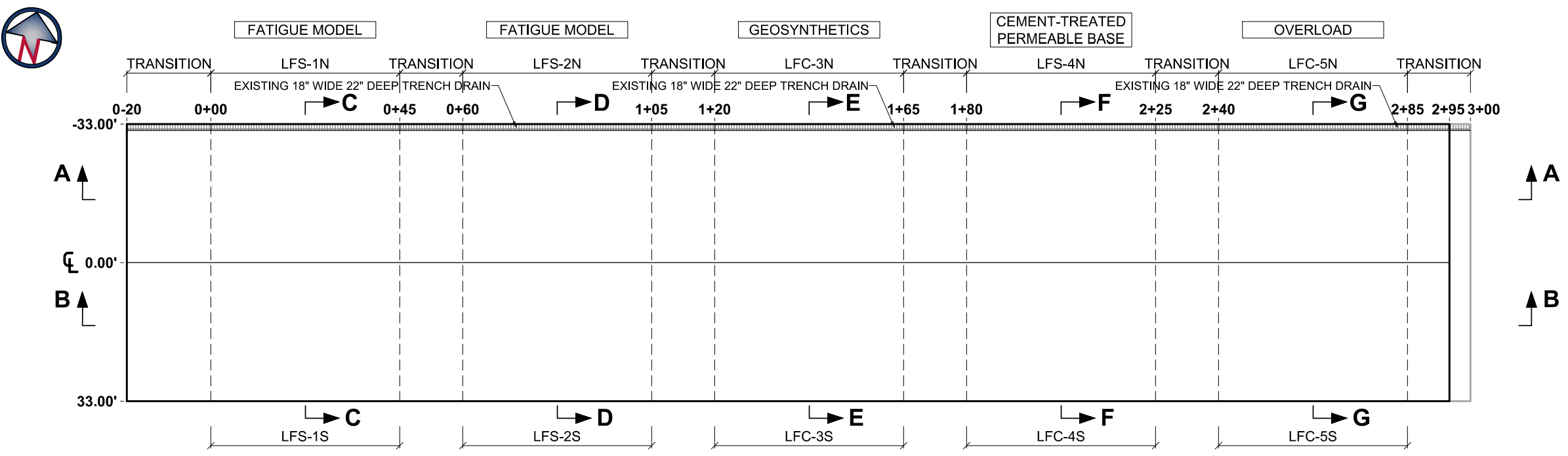
CC9 Design Plan View (Click to Zoom)
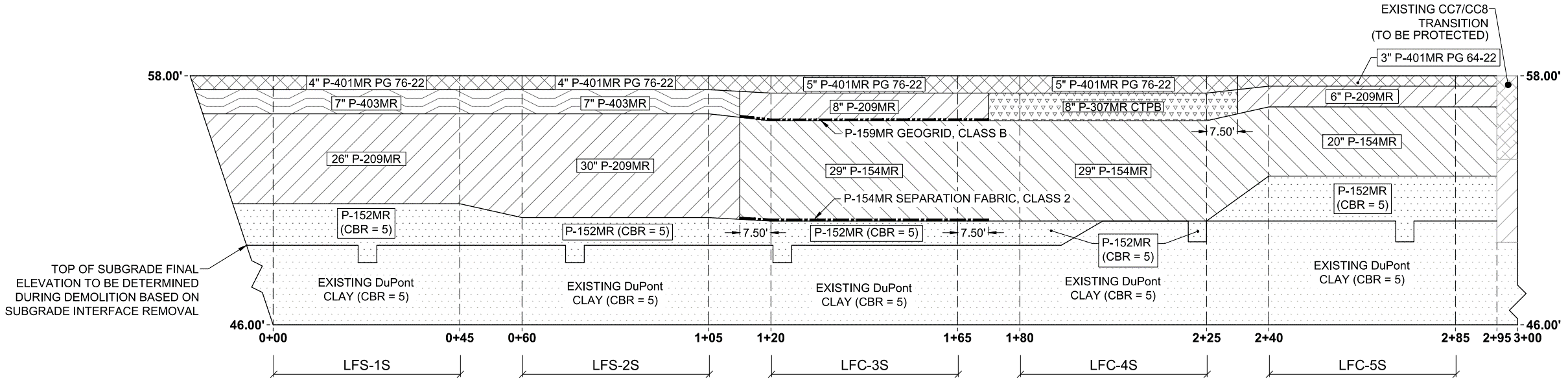
CC9 Design Profile View - North Side - Section AA (Click to Zoom)
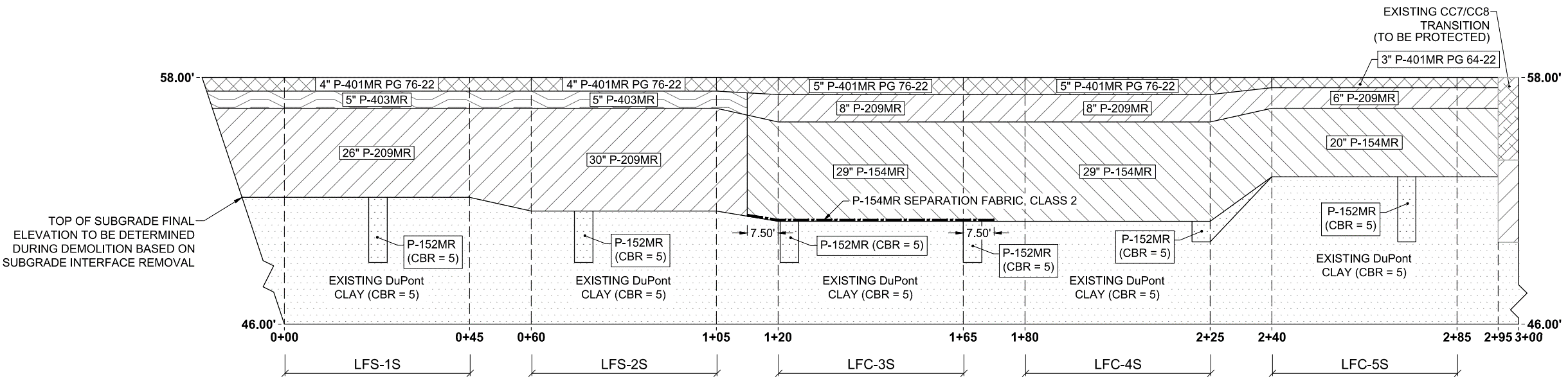
CC9 Design Profile View - South Side - Section BB (Click to Zoom)
Fatigue Model and Base Course Thickness Test Area
The primary objective of the CC9 Fatigue Model and Base Course Thickness test area was to verify the FAARFIELD fatigue model with full-scale field testing. Currently, the FAARFIELD fatigue model relates the number of coverages to failure to the plateau value (PV), which is defined as the ratio of dissipated energy change (RDEC) value at 50% stiffness reduction. The chosen PV is based on extensive lab testing of asphalt beams, and was found to reliably predict the number of cycles to fatigue failure. If the experiment does not verify the current model, the data will be used to refine or adjust the model.
As a secondary objective, the Fatigue Model and Base Course Thickness test compared the FAARFIELD design model to a full-scale test of the thickness of a crushed aggregate base course (P-209) layer.
The Fatigue Model and Base Course Thickness test area was built from station 0+00 to 1+05 and consisted of four test items (LFS-1N, LFS-1S, LFS-2N, and LFS2S). All sat on low-strength P-152MR subgrade (CBR of 5%) and had the same thickness of P-401MR asphalt surface layer. “MR” indicates the material is modified for research purposes. Base design consisted of two material layers, P-209MR crushed aggregate base course and P-403MR asphalt base course, with two different thicknesses for each. Each item had a unique base thickness structure, but could still be compared to each other.
Geosynthetics Test Area
The primary objective of the CC9 Geosynthetics test area was to investigate the effect of geosynthetics on the performance of flexible airport pavements. FAARFIELD does not currently consider these effects. Sources outside the aerospace industry have shown extended pavement life using geosynthetics.
The Geosynthetics test occupied the area from station 1+20 to 1+65 and consisted of two test items; one north and one south of centerline (LFC-3N and LFC-3S). The south test item was built on low-strength P-152MR subgrade, with P-154MR subbase, P-209MR base, and P-401MR asphalt surface layers. A Class 2 P-154MR separation fabric was installed on top on the subgrade layer. The north test item is identical except for the addition of P-159MR Class B Geogrid between the subbase and base layers. Item LFC-4S in the CTPB area served as a control section for this area.
Cement Treated Permeable Base (CTPB) Test Area
The primary objective of the Cement Treated Permeable Base (CTPB) test area was to evaluate the performance of the P-307MR CTPB course on flexible airport pavements. In addition, a secondary objective was to provide an additional dataset for the Fatigue Model test area’s primary objective.
The CTPB test occupied the area from station 1+80 to 2+25 and consisted of two test items (LFC-4N and LFC-4S). Both test items were built on low-strength P-152MR subgrade, followed by P-154MR subbase, a base material, and P-401 asphalt surface course. While thicknesses are identical, the base material differs. The south test item acted as the control with P-209MR crushed aggregate base course, while the north test item had P-307MR CTPB course.
Overload Test Area
The primary objective of the CC9 Overload test area was to follow up the findings of the CC7 Overload testing with additional data. In CC7 it was found that limiting subgrade vertical strain may be used as criterion for allowable overload. Additional data is intended to support the development of strain criterion for allowable overload in flexible pavement.
The Overload test occupied the area from station 2+40 to 2+85 and consisted of two test items (LFC-5N and LFC-5N). The items are identical with a low-strength P-152MR subgrade, P-154MR subbase, P-209MR crushed aggregate base, and P-401MR asphalt surface course. The difference between them is the trafficking plan; the north item will be subjected to overloading prior to normal loading, which is identical for both items.
CC9 construction, testing, and results in the form of webpages, photographs, reports, and databases can be found in the tables below.
Construction
Reports and Analysis